The state of aesthetic medicine in the UK: a proposed framework
A personal proposal for clearer training routes, clinical leadership, supervised procedural practice and a phased transition in UK aesthetic medicine.
Who should lead a clinic, who should deliver treatment, and where should responsibility sit?
Have you heard of the "Medic vs. Non-Medic debate" in aesthetic medicine in the UK?
“Good afternoon. I’m your non-pilot advanced aviator. We’ll be taking off shortly.”
You would probably have a follow-up question if you heard that announcement whilst sitting on a plane.
You have been told what someone is not, followed by an impressive-sounding title. The information you actually need is still missing.
We tolerate that missing information rather too easily in aesthetics.
The debate usually arrives at a familiar question: should people without medical qualifications perform aesthetic procedures?
My answer at the end may surprise you!
But first, we need to explain how the UK arrived at this argument.
For colleagues outside the UK, some context
The UK does not have one uniform licence covering every non-surgical aesthetic procedure. Medicines law, professional standards, provider regulation and national arrangements overlap. There are controls, but they do not form one consistent entry pathway.
Botulinum toxin is a prescription-only medicine. Prescribing and administering it are separate acts, with requirements for lawful prescribing and administration under appropriate directions. Some adult dermal filler treatments remain available from people outside regulated healthcare professions.Parliamentary briefing
The position is also changing:
- Englandis consulting on restricting specified high-risk cosmetic procedures to particular regulated healthcare professionals and bringing providers into CQC regulation. These are proposals, not an already implemented blanket restriction on aesthetic practice.Current consultation
- Scotlandpassed legislation in 2026 establishing a new framework for specified non-surgical procedures. Implementation is ahead, with the new offences not taking effect before September 2027.Scottish Government
- Wales and Northern Irelandhave different arrangements and have not established equivalent comprehensive schemes. Existing healthcare, medicines and other applicable controls still matter.Senedd Research,Northern Ireland ministerial answer
That is the background to a debate that has become dominated by two words: “medic” and “non-medic”.
A category is not a qualification
In the UK aesthetics sector, “medic” commonly means someone from astatutorily regulated healthcare profession, rather than simply a medical doctor.
“Non-medic” is generally used for someone outside those professions. It does not mean that person has no qualifications of any kind. It leaves unanswered whether their qualifications are relevant to the work being offered.
Nurses, dentists, pharmacists, dental hygienists and allied health professionals have their own education, identities and responsibilities. We should name those professions accurately. Grouping them together does not make their preparation interchangeable.
If you are a beautician, say beautician. If you are a nurse, say nurse. If you are a doctor, say doctor. And if you are a dentist, say dentist.
Then explain the qualifications relevant to your work.
Thenon sequiturappears when the description is made to support a conclusion it cannot establish: “not a medic”, therefore qualified to perform a particular procedure or "a medic", therefore qualified to perform a particular procedure. These conclusions do not follow.
In my earlier article,Stop calling yourself an injector, I questioned what disappears when we reduce a professional to a technical act. Here, we are defining someone by an absence instead. Neither description explains enough about preparation, judgement or responsibility.
We are still asking the wrong question
“Should non-medics inject?” gives the label the status of a professional category before the discussion has begun.
The question I would rather answer is:
Should people without medical qualifications carry out certain procedures?
And as I said in the beginning my position may surprise you. I'm not against people without medical qualifications injecting or performing certain aesthetic procedures!
BUT!
My answer is a QUALIFIED yes.
I’ll explain the qualification in that answer below. My position is based on the fact that learning a procedure does not, by itself, equip someone to decide which patient needs it, prescribe where required, manage the full clinical pathway or supervise others.
Before treatment, somebody must assess the person, consider their history and expectations, discuss alternatives and decide whether to proceed at all. Afterwards, somebody must provide review, recognise complications and arrange further help.
Competence to perform a procedure and competence to lead the service around it are different thresholds.
First, recognise the field and define its curriculum
As the great Arnold Schwarzenegger once said: "No complaining about a situation unless you're prepared to do something to make it better!"
So, here's my "proposal". I've thought about a framework that I think could very easily be implemented and solve the entire problem! (Yes! Seriously!)
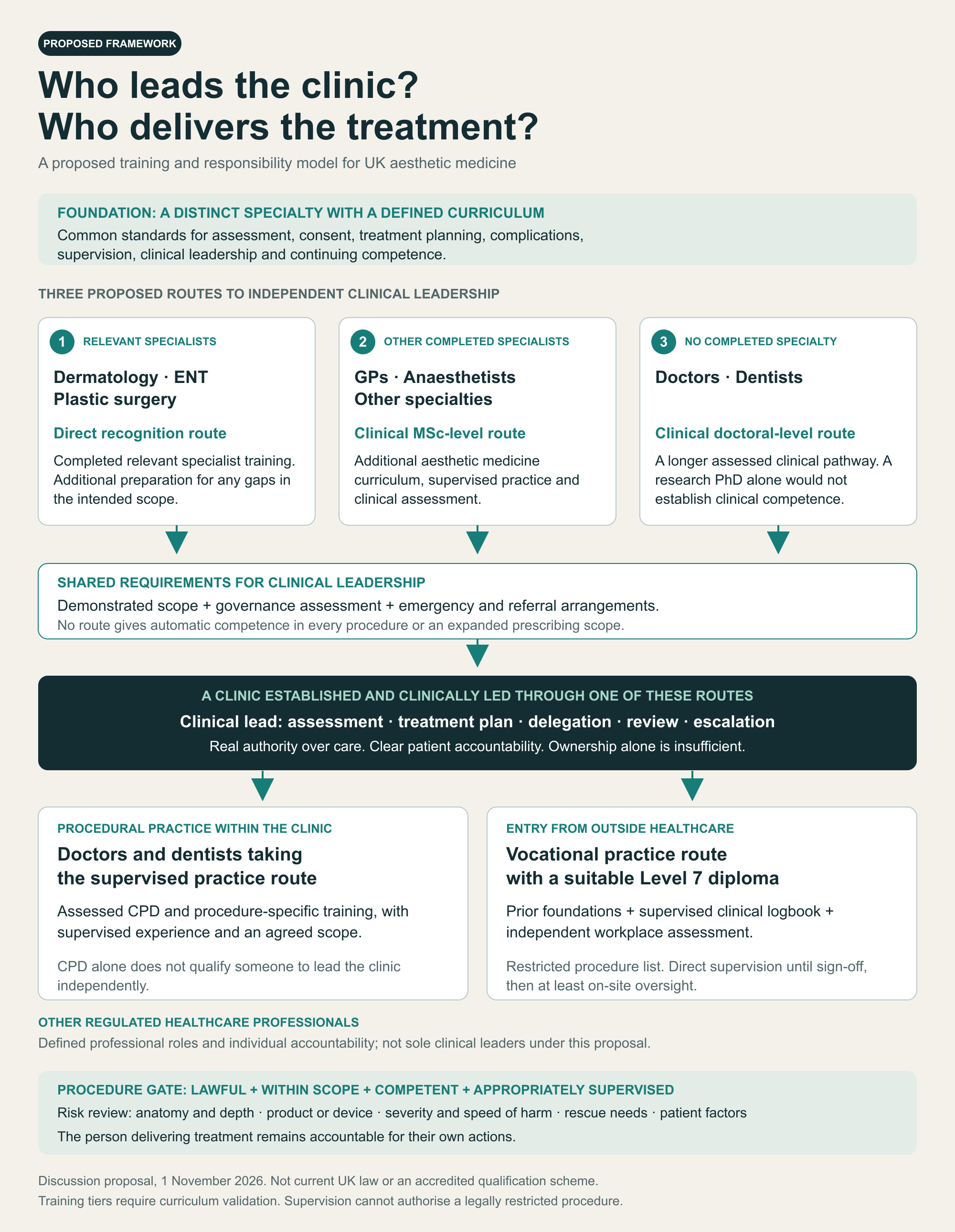
My framework starts with aesthetic medicine being recognised as a distinct specialty with a defined curriculum and assessed clinical capabilities. Aesthetic medicine does not currently appear as a standalone specialty on the GMC’s approved postgraduate curricula list. That is part of the structure I would like to change.GMC curricula
Three routes to independent clinical leadership
1. Relevant completed specialist training
For doctors who have completed relevant specialist training indermatology, ENT or plastic surgery, I would provide a direct recognition route to establishing, operating and clinically leading an aesthetic medicine clinic.
That would recognise substantial prior specialist education without requiring an additional general aesthetic degree by default. It would still require a common governance assessment and a defined clinical scope. Unfamiliar procedures and gaps in relevant expertise would require additional preparation.
2. GPs and other completed specialists
ForGPs and other doctors with completed specialist training, such as anaesthetists, I would require additionalclinically assessed MSc-level education in aesthetic medicinebefore independent clinic leadership.
Their existing expertise should count. The additional pathway should establish the aesthetic assessment, treatment planning, supervision and service leadership capabilities needed for this field.
3. Doctors and dentists without completed specialty training
Fordoctors and dentists without completed specialty training, I would propose a longer,clinically assessed doctoral-level pathwaybefore independent clinic leadership.
By doctoral-level, I mean the depth of a substantial clinical training programme with supervised experience and direct assessment. A research PhD alone would not establish the ability to assess patients, supervise treatment or manage a clinical service.
There would also be a procedural route. Doctors and dentists could undertake assessed procedure-specific training and CPD, then deliver defined treatments within a clinic established and clinically led through one of the three leadership routes.
CPD could prepare someone for specified work within that service. It would not, by itself, qualify them to lead the clinic independently.
Nurses, pharmacists and other regulated healthcare professionals would have important roles delivering care within their professional scope and demonstrated competence. Their qualifications and individual accountability should be recognised.
However,under my proposed framework, those qualifications alone would not permit someone to operate as the sole responsible clinical lead of an aesthetic medicine clinic. I would reserve that role for clinicians completing one of the leadership routes above. My position is that preparation for a defined professional role, including independent prescribing where held, should not automatically be treated as equivalent to the breadth of medical assessment and service responsibility required here.
That is a proposed threshold for sole clinical leadership, not a claim that these professionals currently lack the right to practise independently within their existing scope. Commercial ownership and clinical leadership remain separate questions.
A vocational route for entrants from outside healthcare
For people entering from outside healthcare, I would propose a structured vocational route into a defined procedural role. We may not need to invent an entirely new qualification:a suitable regulated Level 7 diploma in aesthetic practice could provide the qualification component, provided its entry requirements, curriculum and clinical assessment meet the standards of this framework.
There are already Level 7 aesthetic qualifications with entry routes based on relevant prior aesthetic education as well as healthcare qualifications. That does not make every course appropriate for every entrant, or establish that any particular diploma satisfies this proposed framework.Example awarding-body specification
A Level 7 diploma and an MSc can sit at the same qualification level while differing in content, volume and purpose. The procedural route and the clinical leadership route must therefore be distinguished by their full curriculum, supervised experience and assessment, rather than the level number alone.Qualification levels
It would require foundational anatomy and physiology, recognition of skin pathology red flags, infection prevention, communication and consent, safeguarding, emergency recognition and basic life support.
Simulation would precede supervised clinical work. A supervised logbook and independent workplace assessment would establish competence for specified tasks. Attendance alone would not be enough.
The eventual role would be bounded by an explicit list of permitted procedures. There would be no independent diagnosis, prescribing or autonomous treatment planning through this route.
Direct supervision would continue until competence was assessed and signed off. Thereafter, the minimum would be continuing on-site clinical oversight, with direct supervision retained wherever the procedure or patient required it. Some procedures would remain excluded altogether.
Build the clinic around clinical responsibility
In my proposed system, the authority to establish and operate an aesthetic medicine clinic would sit with clinicians meeting the leadership requirements above. Where a business has other owners, the clinical lead must have genuine control over clinical standards and the authority to stop inappropriate care.
The responsible clinical lead would retain oversight of assessment, treatment planning, appropriate delegation, review and escalation. The person performing treatment would remain accountable for their own actions. This distinction is consistent with the GMC’s separation of delegation decisions, overall patient management and the individual colleague’s actions.GMC delegation guidance
Patients should know who assesses them, who treats them and who reviews a concern. Records and outcomes should be reviewed, with functioning arrangements for complications and referral.
Training providers, manufacturers and congresses should publish entry requirements, learning outcomes, assessment methods and the limits of what their training establishes.
If this were agreed tomorrow, how would we get there?
A credible framework needs a credible transition. We cannot announce new qualifications and assume that training places, supervisors, assessors and regulatory capacity will appear overnight.
I would propose two transition periods, measured from a published commencement date once the standards, recognised pathways and application process are available.
Five years for existing professionally led clinics
Existing clinics led by statutorily regulated healthcare professionals, with any registration already required for their services, would haveup to five years to meet the new leadership and training requirements.
They would need a documented transition plan identifying their future clinical lead, any education or assessment gaps, and how those gaps would be addressed. Existing competence and experience could count through independently assessed recognition of prior learning. Time served alone would not establish equivalence.
For a nurse-led or pharmacist-led clinic, this would mean appointing a clinical lead who meets one of the proposed leadership routes by the end of the transition. It would not require the owner to abandon their profession or automatically give up ownership.
Two years for clinics led from outside regulated healthcare
Businesses whose clinical leadership currently sits with someone outside a statutorily regulated healthcare profession would haveup to two years to restructure or cease the procedures covered by the new framework.
Restructuring could mean appointing an appropriately qualified clinical lead, completing any required provider registration, and moving procedural staff onto the recognised qualification and supervision pathway. Employing a clinician in name only would not be enough.
By the deadline, they would need to demonstrate compliance or stop offering the affected procedures. Other lawful beauty services could continue. Changing the company name or ownership structure should not restart the clock.
In England, the proposed registration arrangements would need to align with CQC’s statutory remit; in Scotland, with Healthcare Improvement Scotland, with corresponding arrangements elsewhere. Where a service currently falls outside a regulator’s remit, legislation would need to establish the new requirement.
A transition is not a safety exemption
From the outset, all providers would need to meet existing law and the framework’s immediate safety conditions: an identified accountable professional for clinical decisions, verified competence for the work undertaken, appropriate insurance or indemnity, clear supervision and functioning arrangements for complications and referral.
A five-year education window would not permit five more years of unsafe practice, expand prescribing rights or authorise otherwise restricted procedures. New entrants would meet the new entry requirements from commencement, rather than receive the same transitional allowance as existing businesses.
The foreseeable difficulties are substantial: shortages of training places and supervisors, cost for small clinics, regulatory capacity and the risk that nominal supervision becomes a business model. Patients also need continuity if a clinic restructures or stops providing treatment.
I would address those issues through phased admissions, assessed recognition of prior learning, published qualification standards, proportionate supervision limits, and funded regulatory implementation. Clinics changing their services would need a plan for ongoing care, records, outstanding treatment commitments and complications.
My invitation is to debate the substance: which capabilities justify independent leadership, whether these academic levels are appropriate, which procedures could be delegated and what supervision each would need.
Name the role. Demonstrate the competence. Make responsibility visible.
I'm very interested to learn your opinions! Please do feel free to comment.